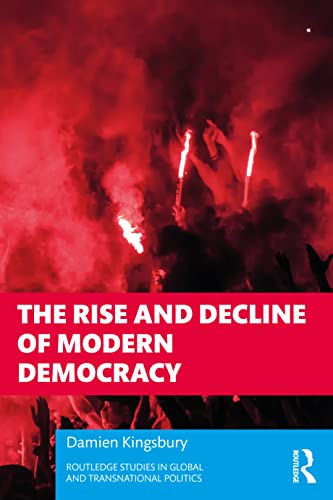
The rise and decline of modern democracy / Damien Kingsbury.
Publisher: New York : Routledge, 2023.Edition: First editionDescription: 245 p. ; 23 cmISBN:- 9781032218168
- JC 423 K56R 2023
| ประเภททรัพยากร | ห้องสมุดที่อยู่ปัจจุบัน | หมวดหมู่ | ตำแหน่งจัดวาง | เลขเรียกหนังสือ | สถานะ | วันกำหนดส่ง | บาร์โค้ด | จำนวนรายการจอง | |
|---|---|---|---|---|---|---|---|---|---|
 General Book
|
National Assembly Library of Thailand | General Book collection | General Book shelves | JC 423 K56R 2023 (เรียกดูชั้นหนังสือ(เปิดด้านล่าง)) | พร้อมให้บริการ | 3961214572 |
หมวดหมู่: General Book collection ปิดเครื่องมือเรียกดูชั้นหนังสือ (ซ่อนเครื่องมือเรียกดูชั้นหนังสือ)

|

|

|

|

|

|
ไม่มีภาพปก | ||
| JC 423 I57D 1998 Democracy : its principles and achievement | JC 423 I65 2014 The internet and democracy in global perspective : voters, candidates, parties, and social movements / | JC 423 K12 Democracy, east and west : a philosophical overview | JC 423 K56R 2023 The rise and decline of modern democracy / | JC 423 K87D 2013 Democracy in retreat : the revolt of the middle class and the worldwide decline of representative government / | JC 423 L485 2018 How democracies die / | JC 423 M3 1960 An introduction to democratic theory |
Introduction -- Drivers of Political Change -- Ebb and Flow -- Challengers -- Compromise -- Decline -- The Radical Right -- The Future is Not Written -- Conclusion: With a Bang?
"The Rise and Decline of Modern Democracy assesses the rise of, subsequent political challenges to, and decline of, contemporary liberal democratic processes, in particular since the 'third wave' of democratisation from the 1990s. Democracy is in global decline. Fewer countries are democratic and fewer people, globally, live in substantive democracies. Autocracy is now the dominant political form and the future looks, at best, challenging for the retention of such democracies that remain. As they did a century ago, nationalism and populism have again reared their ugly heads, and more people are claiming that democracy no longer addresses their most compelling needs or interests. This book examines what democracy is and the circumstances that allowed - even encouraged - it to arise. Democracy has been a product of a need to find a political model that mediates between competing interests, building on conducive conditions. However, there have since been fundamental changes to those conditions, imbalances within democratic countries and between countries, that have diminished the strength of the democratic proposition. The question now arises as to whether democracy can continue as a matter of political will. Challengers to democracy, from the radical Right in developed countries to populist autocracy and state-centred authoritarianism in developing countries, have increasingly shown this may not be the case. Democracy may survive, as this book concludes, but is likely to do so only with more substantial and conscious commitment to the democratic project, with recognition of the need to replenish the fertility of the political soil in which democracy grows. This wide-ranging and empirically and theoretically rich book will be of interest to students, scholars and researchers of political science, international relations, history and democracy"-- Provided by publisher.
ไม่มีความคิดเห็นใด ๆ ต่อชื่อเรื่องนี้